How Many Goblins Does It Take to Kill a Tarrasque in D&D 5e?
How many goblins kill a Tarrasque in D&D 5e? BattleCast tests 400-600 Goblin Warriors, kiting, 5e vs 2024 rules, and replayable fights.
The clean answer is: about 500 Goblin Warriors if they kite well, or 600 if you want the result to be reliable under default smart tactics.
That is a deeply stupid number in the best possible way. It is also a useful little rules lesson: the Tarrasque does not lose because goblins are strong. It loses because enough bad attacks eventually become a pile of natural 20s.
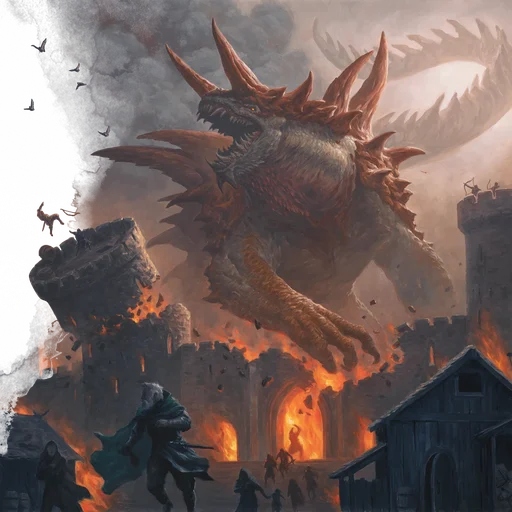
How many tiny crit-fishers does it take to bring down the big one?
The result is not "a lot" in the abstract. It is a specific breakpoint where enough shortbows survive the first few turns to roll enough natural 20s.

That was the clean 5/5 kill count in a 60x60 practical arena with smart default tactics.
When the goblins deliberately preserve distance, 500 killed the Tarrasque in all 5 threshold trials.
Below the reliable line, the fight becomes a race between critical hits and Thunderous Bellow.
A +4 shortbow cannot hit except on a natural 20 at normal range. At long range, it needs double 20s.
What exactly did I test?
BattleCast put Goblin Warriors against the current BattleCast Tarrasque model in open arenas. The main benchmark was a 60x60 grid, Tarrasque near the center, goblins distributed in rings around it, no terrain, and actual deaths only. If the Tarrasque was still alive at the round cap, that was not counted as "goblins killed the Tarrasque."
This matters because the monster is not a training dummy. The tested Tarrasque has 697 HP, AC 25, resistance to bludgeoning, piercing, and slashing, Thunderous Bellow in a 150-foot cone, World-Shaking Movement, legendary actions, and enough speed to punish cute spacing.
Important rules note: legacy 5e gives a different answer
The goblin result only makes sense against the current BattleCast Tarrasque model, where mundane piercing damage is resisted. Against the older 5e/SRD Tarrasque, ordinary Goblin Warriors cannot solve the fight with shortbows or scimitars at all.
A natural 20 would still hit, but the damage would be nonmagical piercing or slashing. The legacy 5e Tarrasque is immune to that damage type from nonmagical attacks, so the applied damage is 0. Without magic weapons, spellcasters, traps, siege gear, or some other nonstandard source of damage, there is no finite number of ordinary goblin attacks that kills it.
| Rule piece | Legacy 5e Tarrasque | Current 2024 / 5.5e-style model | What it means for goblins |
|---|---|---|---|
| Physical weapon defense | Immune to bludgeoning, piercing, and slashing from nonmagical attacks. | Resistant to bludgeoning, piercing, and slashing. | This is the whole article. Mundane goblin arrows deal 0 damage to the legacy version, but half damage to the current model. |
| Hit points | 676 HP. | 697 HP. | The current monster has a slightly larger HP pool, but resistance still leaves a path through critical hits. |
| Mobility | 40 ft. walk speed. | 60 ft. walk, 40 ft. burrow, 60 ft. climb. | The current monster reaches the swarm faster and has more ways to punish spacing. |
| Battlefield pressure | Frightful Presence, Swallow, multiattack, and legendary actions. | Thunderous Bellow, World-Shaking Movement, multiattack, and legendary actions. | The tested model has brutal area pressure, so the goblins are racing both AC 25 and mass removal. |
| Anti-magic defenses | Reflective Carapace, Magic Resistance, Legendary Resistance. | Reflective Carapace, Magic Resistance, six uses of Legendary Resistance. | This matters less for ordinary goblins, but it is part of why the Tarrasque remains a special case instead of a normal stat block. |
The threshold runs
I used a 60x60 open arena as the main setup: large enough to spread a swarm around a Gargantuan creature, small enough that the result is not dominated by long-range disadvantage. The table counts only actual Tarrasque deaths, not 100-round HP tiebreaks.
| Goblin count | Smart tactics | Smart note | Kiting tactics | Kiting note |
|---|---|---|---|---|
| 400 | 0/5 | Too low on 60x60 | 3/5 | Possible, not stable |
| 450 | 3/5 | The coin-flip zone | 3/5 | Still swingy |
| 500 | 3/5 | Very close | 5/5 | Reliable in this setup |
| 550 | 4/5 | Usually enough | 5/5 | Comfortable |
| 600 | 5/5 | Clean benchmark | 5/5 | Over the line |
The math is already ridiculous before the monster takes a turn
A Goblin Warrior attacks at +4. Against AC 25, normal attacks do nothing unless the d20 lands on 20. A critical shortbow hit rolls 2d6+2 piercing. BattleCast then applies the Tarrasque's physical resistance, so the average applied critical is about 4.25 damage.
That means a normal-range goblin shot contributes roughly 0.21 expected damage: 5% to crit times 4.25 damage. A completely unrealistic line of goblins shooting forever would need around 3,280 shots to chew through 697 HP.
Replay it yourself
The embedded version uses 100 goblins so the page remains readable. For the real threshold fights, use the simulator links below. They load the generated goblin ring, the Tarrasque, the grid size, and the tactics.
Map size matters, but not in the obvious way
I started with larger maps because a swarm this large needs space. Then the data pushed back. Huge maps make kiting possible, but they also put more shots past the goblin's 80-foot normal range. At disadvantage, a goblin needs both d20s to be 20.
450 was already enough in 3/3 trials, but the setup gets noisy because everyone is packed together.
400 started winning sometimes. 600 stayed clean. Smaller maps keep more goblins in normal range.
Best headline setup: enough room to spread, still readable, and no long-range gimmick driving the result.
Huge maps did not make goblins automatically better. Long-range disadvantage turns their crit fishing into double-20 fishing.
What actually kills it?
The decisive window is early. If the Tarrasque gets several strong turns before enough crits land, the goblins vanish. If the goblins land a dense opening wave, the 697 HP pool starts collapsing faster than the monster can remove attackers.
Kiting helped in the practical arena because goblins have the right kit for it: ranged attacks and Nimble Escape. It did not turn the fight into an elegant tactical masterpiece. It mostly bought enough extra shots for the crit math to catch up.
The monster has been changing shape for centuries
The fun part of this question is that "Tarrasque" already had a long history before it entered initiative order. The name points back to the French Tarasque of Provence: a folk monster with a shell, claws, poisonous breath, an impossible appetite, and enough local terror to make a whole town part of the story. D&D takes that origin point and turns it into a tabletop kaiju.
The Tarasque starts in Provence
The French Tarasque is a composite monster from the Tarascon tradition: lion-like head, turtle-like shell, bear claws, serpent tail, poisonous breath, and the recurring image of a beast eating people until St. Martha subdues it.
SourceD&D turns it into the end boss of wandering monsters
The D&D Tarrasque appears in Monster Manual II in 1983 and becomes the game version most players know: a gigantic, singular engine of destruction with absurd armor and anti-magic defenses.
SourceThe public legacy stat block is a different fight
The older 5e SRD/D&D Beyond version has AC 25, 676 HP, 40 ft. speed, nonmagical weapon immunity, Reflective Carapace, Frightful Presence, Swallow, and legendary actions.
SourceThis article uses the current BattleCast Tarrasque
The model tested here has AC 25, 697 HP, 60 ft. walk speed, 40 ft. burrow, 60 ft. climb, resistance to bludgeoning/piercing/slashing, Thunderous Bellow, and World-Shaking Movement.
SourceSo what is the table answer?
If a player asks, "Could enough goblins kill a Tarrasque?" my answer is yes, but the number is absurd. A few dozen get erased. A few hundred can make it bleed. Around 500 becomes a real fight if the goblins behave like goblins. Around 600 is the number I would use as the headline benchmark.
The DM answer is even simpler: never put this on the table unless the point is spectacle. Six hundred creatures is not an encounter. It is a weather event with initiative.
Quick rules answers
How many goblins does it take to kill a Tarrasque?
Against the current BattleCast Tarrasque model, about 500 Goblin Warriors can do it if they kite well. For a reliable default-tactics benchmark, 600 Goblin Warriors was the clean answer.
Can ordinary goblins kill the legacy 5e Tarrasque?
No. The legacy 5e Tarrasque is immune to nonmagical bludgeoning, piercing, and slashing damage, so ordinary goblin shortbows and scimitars deal 0 damage even on a natural 20.
Why can goblins hurt the current 2024-style Tarrasque model?
The current model resists mundane bludgeoning, piercing, and slashing instead of being immune. A goblin still needs natural 20s to hit AC 25, but those critical hits can deal reduced damage.
Can I replay the fight?
Yes. The article includes an embedded 100-goblin replay plus simulator links for 400, 500, and 600 Goblin Warrior setups.
Sources and model notes
Battle data is from targeted BattleCast runs made for this article. Lore and public stat-block context were checked against the sources below.